
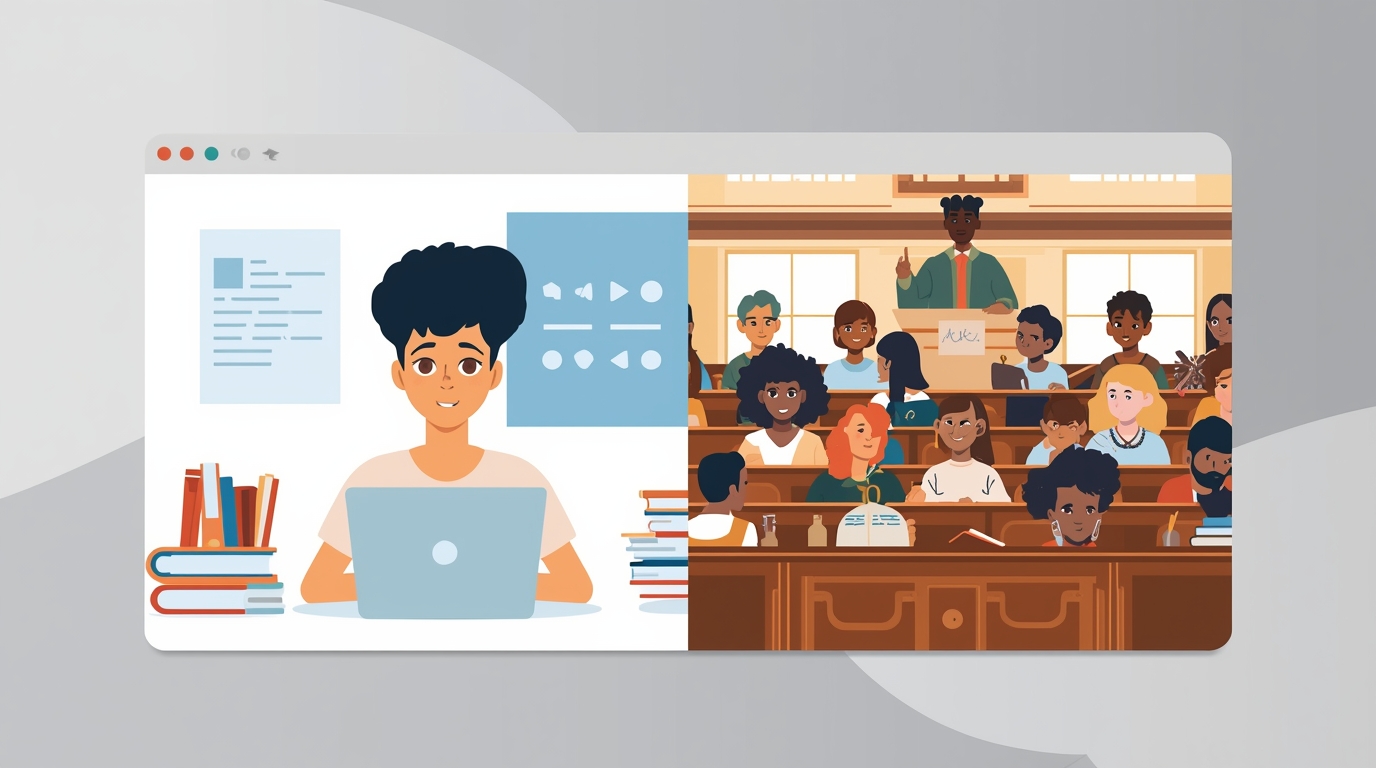
Education has changed a lot over the years. Long ago, students sat under trees and listened to wise teachers. Later, they sat in classrooms with chalkboards. Today, many students sit in front of laptops wearing pajamas and pretending they are “very serious scholars.”
Welcome to the great debate: Online Learning vs Traditional Education.
Which one wins? Is online learning the future? Or does traditional education still hold the crown?
Let’s explore this topic in simple language, with honest thoughts, a little humor, and a balanced view. Grab your coffee (or your school canteen juice), and let’s begin.
Understanding Traditional Education
What Is Traditional Education?
Traditional education is the classic system most of us know. You:
-
Wake up early (sometimes painfully early)
-
Wear a uniform or proper clothes
-
Travel to school or college
-
Sit in a classroom
-
Listen to a teacher face-to-face
This system has been around for centuries and is still the main method of learning in many countries.
Key Features of Traditional Education
Here are the main characteristics:
-
Physical classrooms
-
Fixed schedules
-
Direct interaction with teachers
-
Group learning environment
-
School facilities (libraries, labs, playgrounds)
It’s structured. It’s organized. And yes, sometimes it’s strict.
Understanding Online Learning
What Is Online Learning?
Online learning is education delivered through the internet. Instead of going to school, school comes to you — through your phone, tablet, or laptop.
You attend classes through:
-
Video calls
-
Recorded lectures
-
Online platforms
-
Digital assignments
-
Discussion forums
And the best part? No school bus. No traffic. No “I forgot my homework at home” excuse — because your home is your school.
Key Features of Online Learning
-
Learn from anywhere
-
Flexible schedule
-
Digital materials
-
Virtual classrooms
-
Self-paced options
It’s modern, flexible, and sometimes a little too comfortable.
A Quick Comparison Table
Let’s look at a simple side-by-side comparison.
| Feature | Traditional Education | Online Learning |
|---|---|---|
| Location | Physical classroom | Anywhere with internet |
| Schedule | Fixed timetable | Flexible (sometimes) |
| Interaction | Face-to-face | Virtual |
| Discipline | Structured | Self-controlled |
| Social Life | High | Limited |
| Travel Required | Yes | No |
| Comfort Level | Moderate | Pajama-level comfort |
Now the big question: Which one actually works better?
Let’s go deeper.
Advantages of Traditional Education
1. Real Human Interaction
Nothing replaces face-to-face communication.
In traditional classrooms:
-
You see your teacher’s expressions.
-
You ask questions instantly.
-
You make friends.
-
You laugh together.
You can’t mute your friend in real life (sadly or thankfully).
2. Better Social Development
School is not just about studying. It’s about:
-
Teamwork
-
Communication skills
-
Leadership
-
Public speaking
-
Conflict resolution
When you work in groups or join activities, you develop important life skills.
Online group projects? Let’s be honest. One person works. The others say, “Sorry, my internet was slow.”
3. Structured Learning Environment
Traditional education provides:
-
Clear schedules
-
Supervision
-
Regular exams
-
Physical discipline
For many students, structure is important. Without it, distractions win.
At home, distractions include:
-
Bed
-
TV
-
Refrigerator
-
Social media
-
“Just one more episode”
4. Access to Facilities
Schools and universities provide:
-
Science labs
-
Libraries
-
Sports grounds
-
Art rooms
You can’t do chemistry experiments easily in your kitchen (please don’t try).
Disadvantages of Traditional Education
It’s not perfect. Let’s be honest.
1. Fixed Schedule
You must attend classes at specific times.
Not a morning person? Too bad.
2. Travel Time
Students often:
-
Wake up early
-
Spend hours commuting
-
Face traffic
Sometimes you are already tired before class even begins.
3. Higher Costs
Traditional education may include:
-
Transportation costs
-
Accommodation
-
Printed books
-
Campus fees
It can be expensive.
Advantages of Online Learning
Now let’s give online learning some credit.
1. Flexibility
Online learning allows you to:
-
Study anytime
-
Replay lectures
-
Learn at your own pace
If you don’t understand something, you can rewatch it five times. In a classroom, you might feel shy asking the teacher to repeat.
2. Comfort and Convenience
You can:
-
Study from home
-
Wear comfortable clothes
-
Save travel time
Your classroom could be your bedroom, your balcony, or even your favorite coffee shop.
3. Access to Global Courses
Online education gives access to:
-
International universities
-
Global instructors
-
Specialized courses
You can learn from top institutions without leaving your country.
4. Cost-Effective Options
Many online courses are:
-
Affordable
-
Sometimes free
-
Digital (no printing needed)
It can reduce overall education costs.
Disadvantages of Online Learning
It sounds great — but there are challenges.
1. Lack of Social Interaction
Staring at a screen all day can feel lonely.
You miss:
-
School events
-
Group laughter
-
Casual conversations
Virtual high-fives just don’t feel the same.
2. Requires Strong Self-Discipline
Online learning needs:
-
Time management
-
Focus
-
Motivation
No teacher standing in front of you means you must control yourself.
And self-control is hard when your bed is calling your name.
3. Technical Issues
Common problems include:
-
Slow internet
-
Power cuts
-
Device issues
-
Software errors
Nothing is more stressful than your internet disconnecting during an exam.
4. Limited Practical Learning
Some subjects require:
-
Lab work
-
Hands-on training
-
Physical practice
Online learning may struggle to provide these experiences effectively.
Learning Effectiveness: Which One Teaches Better?
The truth is — it depends on the student.
Some students:
-
Learn better independently.
-
Enjoy flexibility.
-
Prefer digital tools.
Others:
-
Need supervision.
-
Prefer direct interaction.
-
Learn better through discussion.
Let’s compare effectiveness in simple terms:
| Type of Student | Better Option |
|---|---|
| Self-motivated learner | Online Learning |
| Needs guidance and structure | Traditional Education |
| Loves social interaction | Traditional Education |
| Busy working professional | Online Learning |
| Practical skill learner | Traditional Education |
There is no universal winner.
Impact on Mental Health
This is important.
Traditional Education and Mental Health
Pros:
-
Social support
-
Friendships
-
Activities
Cons:
-
Academic pressure
-
Bullying (in some cases)
-
Travel stress
Online Learning and Mental Health
Pros:
-
Less social pressure
-
Flexible schedule
-
Comfortable environment
Cons:
-
Isolation
-
Screen fatigue
-
Lack of emotional connection
Balance is key in both systems.
Technology and the Future of Education
Technology is improving quickly.
Artificial intelligence, virtual reality, and interactive platforms are making online learning more engaging.
In the future, we may see:
-
Virtual reality classrooms
-
AI tutors
-
Hybrid systems
Education is evolving.
The Rise of Hybrid Learning
Many institutions now combine both systems.
Hybrid learning includes:
-
Online lectures
-
Physical workshops
-
Blended activities
It offers:
-
Flexibility
-
Social interaction
-
Practical experience
It might be the real winner.
Cost Comparison Table
Here’s a simple cost breakdown:
| Expense Type | Traditional Education | Online Learning |
|---|---|---|
| Transportation | Yes | No |
| Accommodation | Sometimes | No |
| Printed Books | Yes | Mostly Digital |
| Internet | Optional | Required |
| Campus Fees | Yes | Often Lower |
Online learning often costs less overall.
Career Opportunities and Employer Views
Employers today are more open-minded.
Many companies value:
-
Skills
-
Experience
-
Certifications
-
Practical knowledge
They care less about how you learned and more about what you learned.
However, some fields still prefer traditional degrees, especially in:
-
Medicine
-
Engineering
-
Law
Hands-on practice matters in these areas.
Which One Wins? The Final Verdict
So… who wins?
Drumroll please.
The answer is: It depends on you.
There is no single champion.
-
If you need structure and social life → Traditional education wins.
-
If you want flexibility and independence → Online learning wins.
-
If you want both → Hybrid learning wins.
Education is not a competition. It’s a tool.
The real winner is the student who:
-
Stays committed
-
Keeps learning
-
Develops skills
-
Adapts to change
Whether in a classroom or behind a screen, success depends on effort.
Final Thoughts
Education is evolving, just like technology and society.
Traditional education gives us community, discipline, and hands-on experiences.
Online learning offers flexibility, global access, and convenience.
Instead of asking which one wins, maybe we should ask:
“How can we use both to create better learning experiences?”
Because at the end of the day:
-
A lazy student will struggle anywhere.
-
A motivated student will succeed anywhere.
And yes, whether you are in a classroom or on Zoom — exams are still scary.
Conclusion
Online learning and traditional education both have strengths and weaknesses. Neither is perfect. Neither is useless.
The future of education will likely blend both systems, creating flexible, engaging, and practical learning environments.
